Pages

Showing posts with label Restaurants. Show all posts

Monday, March 22, 2010

The (New) Law of the Land: Nutrition Labeling at Chain Restaurants


H.R. 3590, more commonly known as the health care reform bill passed by the House of Representatives last night, contains a provision I'll bet most people weren't aware of. Deep in the bill, on page 1206, is Section 4205, "Nutrition Labeling of Standard Menu Items at Chain Restaurants." This section, which bears the full force of law once the President signs off on the legislation, requires chain restaurants (those with 20 or more locations) to prominently display the nutrition information for all standard menu items. How prominently? As in the picture above, chains will have to put the calorie content of each item right next to its menu listing. The rule also applies to vending machines.

Similar laws are already on the books in some jurisdictions (New York City, the State of California, and others), but the new federal law will supersede such state and local requirements. The fact that the federal law will preempt the patchwork quilt of local and state rules is significant in part because it is the reason this law was able to pass without much opposition from the industry. Food chains agreed to swallow this bitter pill in order to avoid the costly headache of navigating compliance on a locality-by-locality basis.

This sort of thing is a good reminder that local politics and regulations can matter in a big way, if only because they are so difficult and frustrating for large multi-state and national corporations to navigate.

The celebratory press release from CSPI, here.

Thursday, March 18, 2010

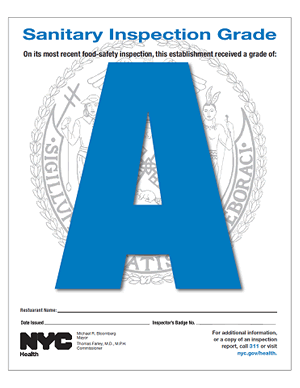
NYC to Require Restaurants to Post Inspection Grades


Following in the footsteps of  Los Angeles and several other major cities, New York will begin requiring restaurants to visibly display their most recent inspection scores for the dining public. Despite some industry opposition claiming that the grades are misleading or will scare consumers unnecessarily, this is an unequivocally good thing.

The posting requirement gives consumers a powerful tool, and gives restaurateurs a powerful incentive to clean up their kitchens. The effectiveness of the measure is evident in Los Angeles, where foodborne illness hospitalizations declined 13% when it took effect.

Other than being good news for New York diners, this bodes well for consumers everywhere. Where NYC leads, other cities and even state and federal authorities often follow. Here's hoping that other cities follow suit. Here in DC, my understanding is that you still have to file a FOIA request to find out whether your favorite pizza place has a rodent problem.


The official Press Release, a very useful FAQ document, and New York Times coverage.

Wednesday, February 3, 2010

Menu Labeling Leads to Healthier Choices, New Studies Show


Great summary over at Food Law Prof Blog of some studies about the effects of menu labeling. A Stanford Graduate School of Business study involving Starbucks stores in New York City (where menu labeling is the law) and a separate study looking at McDonalds conducted by researchers at the University of Washington and the Seattle Children’s Research Institute both found that - surprise, surprise - when people can see the nutrition facts for menu items, they tend to choose healthier ones.

Menu labeling is a win-win proposition: nobody tells restaurants what they can or can't sell, but consumers are empowered to make more informed choices about their food. National menu labeling legislation is expected to go through some time this year, either as part of health care reform or separately.

Tuesday, February 2, 2010

More Salt!

Salt in fine dining, in New York City. Courtesy of the New York Times.

In New York, of course, the mayor is going for a pretty hefty overall salt reduction (see this article for background). This is an interesting, if anecdotal, look at how "oversalted" (from a nutritional, rather than taste perspective... I'd argue that good clam chowder and the corned beef sandwiches are both just about perfect regardless of outsized salt levels) the finer side of restaurant dining is. The verdict? Pretty salty.

Conclusion: if you order something that sounds vaguely salty at a restaurant (even a good one), assume it has even more salt than you'd use if you made it at home. Does this mean not to order or eat it? For heaven's sake no. It's just something to be aware of.