Showing posts with label Inspections. Show all posts
Thursday, March 18, 2010
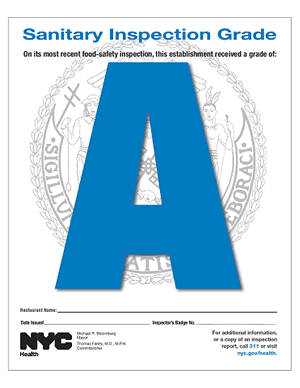
NYC to Require Restaurants to Post Inspection Grades
Following in the footsteps of Los Angeles and several other major cities, New York will begin requiring restaurants to visibly display their most recent inspection scores for the dining public. Despite some industry opposition claiming that the grades are misleading or will scare consumers unnecessarily, this is an unequivocally good thing.
The posting requirement gives consumers a powerful tool, and gives restaurateurs a powerful incentive to clean up their kitchens. The effectiveness of the measure is evident in Los Angeles, where foodborne illness hospitalizations declined 13% when it took effect.
Other than being good news for New York diners, this bodes well for consumers everywhere. Where NYC leads, other cities and even state and federal authorities often follow. Here's hoping that other cities follow suit. Here in DC, my understanding is that you still have to file a FOIA request to find out whether your favorite pizza place has a rodent problem.
The official Press Release, a very useful FAQ document, and New York Times coverage.
Labels:
Food Safety,
Inspections,
New York City,
Restaurants
Monday, February 22, 2010
Cargill Passes the Buck on E. coli Contaminated Patties
Cargill has admitted that it was responsible for making the E. coli O157:H7 contaminated ground beef patties that ultimately paralyzed a Minnesota woman back in 2007. That woman is purportedly suing Cargill for $100 million.
What's interesting about this is that Cargill is aknowledging that it's product was contaminated and directly responsible for the woman's illness, but it is claiming the liability should lie elsewhere. According to the processor, the contaminated beef came from suppliers who claimed it had already been tested. This, combined with Cargill's statement that its actions have been subject to and in adherence with rules dictated by the Federal Meat Inspection Act, add up to Cargill essentially passing the buck down the supply chain to those suppliers who ostensibly failed to identify the contamination.
Two different outcomes would both be in the public interest here, though we're not assured of either of them. If the victim successfully wins a settlement from Cargill, that might force the producer to re-test its meat and demand better from its suppliers. If the victim successfully wins a settlement from the suppliers, that would send the message to these suppliers that processors like Cargill won't protect them from the consequences of their actions. Unfortunately, the most likely scenario is that Cargill will simultaneously deny responsibility and claim that it is impossible to identify exactly which supplier would be liable - essentially arguing that although this woman's illness is clearly somebody's fault, we can't say who, so she can't recover damages.
Good arguments for both stricter testing and inspection requirements, and for true traceability.
A report on this from industry friendly Meatingplace.com.
Labels:
Cargill,
E. coli,
Food Safety,
Foodborne Illness,
Ground Beef,
Inspections,
Traceability,
USDA
Sunday, February 14, 2010
BPI To Post Pathogen Test Results Online
Beef Products Inc. Founder and Chairman Eldon Roth announced at the Nation Meat Association's annual conference in California last week that the company will be posting 100% of their E. coli O157:H7 and salmonella test results on their website from now on. The move is part of BPI's efforts to repair its damaged public image following public and media concern over the company's use of ammonia as an antimicrobial "processing aid" in it's ground beef.
The uproar over so-called "ammoniated beef" is a story in itself. The technique, developed by Roth and proprietary to BPI, was originally given special status by the USDA that allowed it to bypass certain inspection requirements, and was considered a "processing aid," meaning that there was no requirment that meat processed with ammonia be labeled as such. This special treatment was based on research that has been called into question by consumer advocates, and that in any case specified higher concentrations of ammonia than ended up in use. News of contaminated BPI meat raised questions about the reliability of the ammonia process and about a lack of company accountability for the safety of the meat (much of which was sold to the school lunch program), and the company has struggled to regain the public trust.
The new policy represents an admirable move toward greater transparency for a major meat processor. It's too bad that this sort of policy only gets implemented as damage control - here's hoping other major producers will follow suit.
The story, courtesy of meatingplace.com.
Wednesday, February 3, 2010
West Missouri Beef Recalls 14,000 Lbs
Food Safety News reports on the recall of "fresh boneless beef products" from West Missouri Beef. Does this mean you should avoid buying these products at the market today? Nope. The vast majority of the recall (like most meat recalls in our country) affects beef produced and sold back in the end of 2009, some as early as October.
The delay on "voluntary recalls" is a serious problem with our food system. The pending Food Safety Modernization Act in the Senate would help address this problem for FDA regulated foods, but for USDA regulated meat and poultry, we're stuck with the current system for a while at least. Inspector's need the power to detain food that is likely adulterated, and the USDA needs the power to enforce involuntary (and immediate) recalls.
Because the only people the current system is saving are those who buy in bulk, freeze their beef, and diligently compare the labels on that frozen beef against active recalls. And that's not many.
Labels:
beef,
E. coli,
FDA,
Food Safety,
Foodborne Illness,
Inspections,
USDA
Tuesday, February 2, 2010
Food & Water Watch Criticizes Obama's Budget
In a previous post, we supported the new fee-based funding for FDA inspection programs included in the president's budget proposal. The folks over at Food & Water Watch are arguing today that other elements of the budget are less food-safety friendly. Specifically, the group criticizes what it sees as inadequate funding for USDA inspections. The whole story here.
The piece also takes issue with what it sees as support for further development of unsustainable fisheries. Without having read the budget, I can't comment on whether this is accurate. It raises an interesting topic, however: sustainability is the notable exception to my "if you understand what you're eating, then go for it" mentality. We all have the right to eat what we please, regardless of the damage we might do to our bodies or wallets; this doesn't extend to destroying our environment or depleting our food resources to the point of driving species into extinction.
Labels:
FDA,
Food and Water Watch,
Food Safety,
Inspections,
Sustainability,
USDA
Monday, February 1, 2010
Obama Budget Includes $250m+ in FDA Fees on Food and Drug Makers
We learn from the Wall Street Journal today that President Obama's proposed budget will include over $250 million dollars in new FDA fees, paid by food and drug makers, that would help cover the cost of a variety of FDA activities, including food inspections.
Dealing only with the food part of this (drug regulation, while important, isn't really our shtick here), this appears to be a good thing. Food inspections are underfunded and, as a result, often unable to detect contamination early enough or at all. Just look at the history of food-borne illness in this country over the last decade. In these tough times for the federal budget (the proposed freeze on discretionary funding over the next few years), this would mean that FDA funding would be secure, and would fall on the shoulders of an industry that has for too long tried to minimize the role and authority of our nation's primary food safety watchdog.
Please note that this funding depends upon congressional action, specifically on the Senate moving forward on S. 510, the companion bill to one passed in the House last year that would authorize the fees.
More FDA funding for inspections means safer food and a more accountable industry. Safer food and increased accountability mean that when we go to the store we can be confident that we're getting what we think we are, and that it won't make us sick. And that is unequivocally a good thing.
Dealing only with the food part of this (drug regulation, while important, isn't really our shtick here), this appears to be a good thing. Food inspections are underfunded and, as a result, often unable to detect contamination early enough or at all. Just look at the history of food-borne illness in this country over the last decade. In these tough times for the federal budget (the proposed freeze on discretionary funding over the next few years), this would mean that FDA funding would be secure, and would fall on the shoulders of an industry that has for too long tried to minimize the role and authority of our nation's primary food safety watchdog.
Please note that this funding depends upon congressional action, specifically on the Senate moving forward on S. 510, the companion bill to one passed in the House last year that would authorize the fees.
More FDA funding for inspections means safer food and a more accountable industry. Safer food and increased accountability mean that when we go to the store we can be confident that we're getting what we think we are, and that it won't make us sick. And that is unequivocally a good thing.
Subscribe to:
Posts (Atom)
